Henry Kirke Reid’s report on Poe
The Pale Blue EyeHenry Kirke Reid’s report on Poe is a cord-bound packet of yellow sheets, sent to Augustus Landor after inquiries into Edgar Allan Poe’s history. Landor uses it to confront Poe with discrepancies in his self-presentation, but the report’s rushed compilation and Reid’s cautions leave its authority qualified. In the investigation, the document is at once a practical instrument and a visible example of how imperfect information can be made to bear on a person’s credibility.
Commission and Transmission
Reid’s report arrives by mail as an interesting package from Landor’s New York correspondent. It is accompanied by a letter addressed to Landor, which frames the enclosed material as the result of an assignment rather than a finished, definitive inquiry. Reid explains that four weeks had not given him enough time: dispatches from Richmond had only just arrived, and another week or two might have yielded substantially more about Poe. He nevertheless sends what he has, including the results of inquiries in Boston, New York, and Baltimore.
The report’s arrival is therefore marked by a gap between the breadth of its intended inquiry and the time available to conduct it. Reid explicitly warns that it was compiled at great speed and is less complete than it might have been. That qualification matters: the packet offers Landor information from several cities, but its own account of how it was assembled cautions against treating its contents as exhaustive.
Reid also declines payment. He describes the inquiries as not especially strenuous and presents waiving his compensation as a modest way of honoring Amelia Landor’s memory; he adds that he had never sent adequate condolences. His letter makes the report part of a personal exchange as well as a professional service. Reid’s closing observation that New York is less merry without Landor gives the correspondence a note of friendship, without changing the investigative purpose of the enclosed papers.
Findings and Limits
Reid’s central assessment is deliberately guarded. He tells Landor that Poe’s past is marked by dead bodies, but adds that none of those dead has risen to accuse him and that there is no warrant for his arrest. Reid immediately warns that these facts mean nothing as a guarantee of innocence. The report thus supplies neither an exoneration nor a demonstrated criminal charge: it records a troubling reputation while distinguishing that reputation from proof that can be brought against Poe.
When Landor later consults the sheets, he draws on specific corrections to Poe’s accounts. He says the report attributes Poe’s departure from the University of Virginia not to John Allan cutting off his funding, but to ruinous gambling debts. Landor also challenges Poe’s claim to have spent three years at the university, saying that the stay was only eight months. He cites another discrepancy in Poe’s account of swimming seven and a half miles up the James River, which the report places closer to five. These details are not interchangeable accusations: one revises the stated reason for leaving, another changes the length of Poe’s attendance, and the third reduces a claimed feat. Together, Landor uses them to question how reliably Poe represents his own past.
The report’s force in that exchange depends on the distinction between a documented contradiction and a verdict. Landor treats its findings as leverage, even while acknowledging that Reid’s work is incomplete. Reid’s warning about the absence of a warrant and the limits of the inquiry prevents the packet from settling Poe’s guilt; its immediate usefulness is to furnish Landor with concrete grounds for distrust.
The Packet in Confrontation
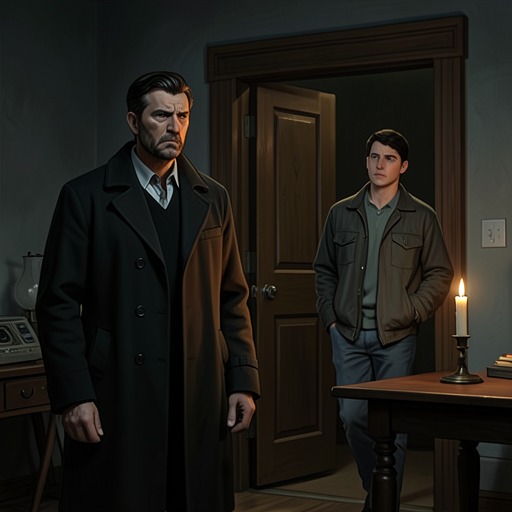
The report becomes materially prominent when Landor retrieves it from a side-table drawer. The yellow sheets are bound with cord; he throws the packet halfway across the bed, where Poe can see it. Asked what it is, Poe is told that Landor had a friend investigate his history because he was hiring him for a job and wanted to know what sort of man he was dealing with, especially one who spoke of killing people. The report’s first function in this scene is practical: Landor presents it as background checking undertaken in connection with their working arrangement.
But the packet quickly becomes a weapon in their argument. Landor calls attention to Poe’s alleged falsehoods and turns from the individual corrections to a broader challenge about what in Poe’s story can be trusted. Poe dismisses the document as a tissue of lies, a phrase Landor adopts with pointed irony before citing the university and swimming discrepancies. The report cannot independently resolve that clash of credibility in the scene. Instead, its contents become the means by which the two men contest who has the right to judge the other and whose account should be believed.
Evidence and Narrative Significance
The report belongs to a wider pattern in the investigation: details acquire weight through their sources, circumstances, and limits. In a separate examination of Leroy Fry’s body, a doctor identifies a contusion and explains that a bruise is unlikely to have been inflicted after death because it depends on circulating blood. Epaphras Huntoon’s account, meanwhile, emphasizes how darkness and the small lantern made discovery uncertain: a step to either side might have left him unaware of Fry. These are not findings attributed to Reid’s report; set beside it, they show how the inquiry depends on evidence whose meaning is bounded by what a witness could see or an examination could establish.
A later challenge to a guard’s account similarly turns on the wording of a prior statement: Landor points out that the guard had first said Lieutenant Kinsley relieved him. Such details clarify the report’s place in the book’s investigative method. Reid supplies information about Poe’s past, but Landor’s use of it depends on distinguishing what the packet actually supports from the larger suspicion he wants it to sustain.
As an object, the yellow-sheet packet moves from correspondence into confrontation. Its cord binding and abrupt passage across the bed make a private inquiry visible to Poe; its contents let Landor test Poe’s claims, while Reid’s caveats keep the document from functioning as conclusive proof. The report’s significance lies in that tension: it can expose discrepancies and reshape an alliance, yet the evidence it gathers remains partial, and its interpretation belongs to the people who put it to use.